
Not so much theological reflection this week. I’m recovering from a man-cold (learn more here), so I’m not back to firing on all cylinders yet. I’m still going to write, even if it’s a short entry, because I know myself, and I know that I need to make writing a scheduled, disciplined endeavor if I’m going to make it work.
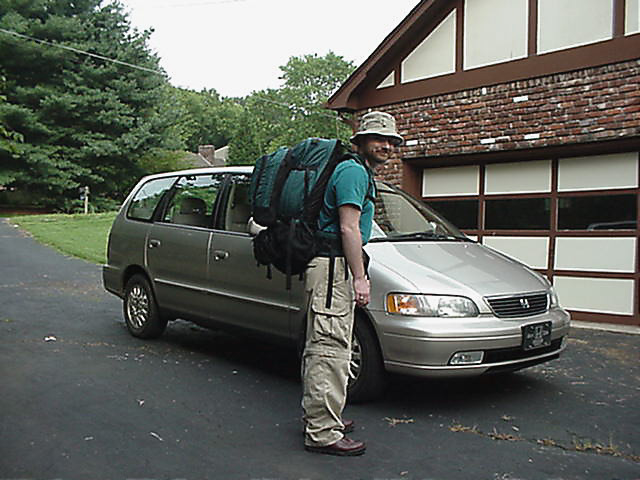
It was not long after my trip to Alaska that I came to think of grief as a large backpack. There’s a lot of stuff in there. It’s heavy. It’s off balance. It’s got poky, sharpy things in there. Turning around is a challenge, especially in tight spaces, because you accidentally hit things or knock things.
The first couple miles of a hike with a pack like that are tough. It can be hard to find places to stop and take off your pack for a rest. But when you do find those places you can take the time to open the pack and reexamine what you have. You can rebalance. You can move the poky, sharpy things so they’re not in your ribs. The farther you go, the more you get the pack customized to you. Yes, you’re carrying a load, but you figure out what you need to do to make it manageable.
It’s even better if you’re traveling with friends whose packs aren’t as heavy. They can help carry some of your load along the way.
Bear ye one another’s burdens, and so fulfil the law of Christ.
Galatians 6:2 KJV
OK, though I promised at the beginning not so much theological reflection, reflections have yet unbidden come. I’m reminded of a passage from Charles Williams’ novel Descent into Hell, where young Pauline Anstruther, who has been haunted throughout her life by near encounters with her doppelgänger, brings herself to discuss the matter with a poet and playwright. He offers to carry her burden of fear so that the next time she sees her doppelgänger, she can fearlessly meet herself face to face.
She said, still perplexed at a strange language: “But how can I cease to be troubled? will it leave off coming because I pretend it wants you? Is it your resemblance that hurries up the street?”
Descent into Hell, from the chapter “The Doctrine of Substituted Love”
“It is not,” he said, “and you shall not pretend at all. The thing itself you may one day meet-never mind that now, but you’ll be free from all distress because that you can pass on to me. Haven’t you heard it said that we ought to bear one another’s burdens?”
“But that means-” she began, and stopped.
“I know,” Stanhope said. “It means listening sympathetically, and thinking unselfishly, and being anxious about, and so on. Well, I don’t say a word against all that; no doubt it helps. But I think when Christ or St. Paul, or whoever said bear, or whatever he Aramaically said instead of bear, he meant something much more like carrying a parcel instead of someone else. To bear a burden is precisely to carry it instead of. If you’re still carrying yours, I’m not carrying it for you–however sympathetic I may be. And anyhow there’s no need to introduce Christ, unless you wish. It’s a fact of experience. If you give a weight to me, you can’t be carrying it yourself; all I’m asking you to do is to notice that blazing truth. It doesn’t sound very difficult.”
Stanhope does, mystically, take up her burden of fear, enabling her later in the book to encounter her doppelgänger without running away in terror. I’ve tried to write more to this paragraph, but everything comes out spoilery so you’ll just have to read the book for yourself!
C. S. Lewis, a friend of Williams, ran with Williams’ idea of substituted love in his later novels. He seems to have taken such a possibility as more than just a romantic literary idea during the time his wife, Joy Davidman, suffered greatly from her cancer. From the essay “It Was Allowed to One”: C. S. Lewis on the Practice of Substitution, published in “Mythlore: A Journal of J. R. R. Tolkien, C. S. Lewis, Charles Williams, and Mythopoeic Literature”, vol. 35, no. 1:
This later period in Lewis’s life gave him an opportunity to engage in and reflect upon the experiential aspect of substituted love. What had previously been a spiritual principle which Lewis had acknowledged and developed in a literary context became a matter of immediate importance. The daily suffering of his wife drove Lewis to plead with God that her pain would be relieved, even if it meant taking that pain upon himself. Lewis’s experiences of substituted love and his later reflections on this experience in the aftermath of his wife’s death appear to be marked by the same ambivalence that characterized his earlier considerations. By examining his letters and accounts from his friends during this period we gain a sense for how Lewis’s thinking about substitution developed in the lived context of physical suffering and marital loss. His pained ruminations on substitution in A Grief Observed reveal a continued wrestling with the metaphysics of substitution in the face of that loss.
Davidman’s aggressive cancer ensured that the couple’s marriage would be brief and its ending traumatic. Yet there were periods of recovery in which they were able to enjoy married life. At the beginning of the first such period, Lewis wrote to Sheldon Vanauken in November 1957 and noted that “the cancerous bones have rebuilt themselves in a way quite unusual and Joy can now walk,” observing that this event coincided with an apparent attack of osteoporosis on Lewis’s part. Lewis was not satisfied to view these gains and losses of health as merely coincidental: “The intriguing thing is that while I (for no discoverable reason) was losing the calcium from my bones, Joy, who needed it much more, was gaining it in hers. One dreams of a Charles Williams substitution! Well, never was a gift more gladly given; but one must not be fanciful” (Collected Letters III.901). Around the same time he wrote to Sister Penelope, “I was losing calcium just about as fast as Joy was gaining it, and a bargain (if it were one) for which I’m very thankful” (qtd. in Hooper 85). Though he strikes a cautious tone in these letters, it is clear that Lewis believes that something of a miraculous nature had taken place; and that miracle might even have been an act of exchange. In conversation with Nevill Coghill, it sounds as though Lewis was more confident of the substitutionary character of Davidman’s recovery and his own pain. Coghill recounts questioning Lewis on this subject, remembering that “he told me of having been allowed to accept her pain. ‘You mean’ (I said) ‘that her pain left her, and that you felt it for her in your body?’ ‘Yes,’ he said, ‘in my legs. It was crippling. But it relieved hers’” (Coghill 63). These comments reveal just how deeply Williams’s influence ran with Lewis. More than an issue of literary or imaginative influence, Lewis appropriated Williams’s understanding of the spiritual structure of the world and its serious consequences for interpersonal relationships.
“It Was Allowed to One”: C.S. Lewis on the Practice of Substitution, Andrew C. Stout
I give thanks to God for the many friends who have helped lighten my load over the years, both known to me and unknown, and for any way that God has given me to lighten the load of others. God bless us all as we carry one another’s burdens, and so fulfill the law of Christ!


 The Joyful Widower
Leave a reply to JT Cancel reply